
Soho Chinese Restaurants: A Historic Journey
Walk down Leicester Street on any afternoon, and let the rich history of Soho Chinese restaurants hijack your senses with authentic flavours. The sharp, savoury scent of star anise and roasted meats mingles with the damp London air. Meanwhile, the rhythmic clatter of porcelain echoes through steamed-up windows. Here, in the pulsating heart of Soho’s Chinatown, stands Joy King Lau – a towering, multi-story institution that serves as far more than just a place to eat.
It is a living museum. Behind its unassuming doors lies a culinary lineage that stretches back thousands of miles and hundreds of years, tracing its roots all the way to the ancient trading ports of the Maritime Silk Road.
The Pearl River Delta: Inspiring Soho Chinese Restaurants
 To understand Joy King Lau’s menu, you must first look to Guangzhou. Historically, this city serves as the capital of China’s Guangdong province. Long before Leicester Street existed, Guangzhou was the eastern terminus of the Maritime Silk Road.
As a massive international port city, it became a cultural and culinary melting pot. Arab, Indian, and European merchants brought exotic spices, new ingredients, and varied cooking techniques. Unlike other regional Chinese cuisines that rely heavily on numbing spices or heavy oils, Cantonese chefs learned to use these new imports with incredible restraint.
“The philosophy of Cantonese cuisine was born on the Silk Road: use the finest, freshest ingredients brought by the tides of trade, but never mask their natural flavours.”
This historical philosophy emphasised freshness, delicate balances, and precise timing. Consequently, Leicester Street kitchens actively apply this exact approach today.
The Great Migration to Soho
The journey of Cantonese cuisine to London is a story of resilience and adaptation. The original London Chinatown was established in the late 19th century in Limehouse, East London, largely by Cantonese sailors employed by the East India Company. However, it wasn’t until the post-World War II era that the community migrated to the West End.
Cheap commercial leases and the bustling theatre district drew Cantonese immigrants to Soho. Consequently, these newcomers transformed the local alleys. Joy King Lau emerged as a cornerstone of this vibrant hub. Furthermore, it provided a vital sanctuary for the diaspora. Families preserved familiar home rituals there. Meanwhile, the restaurant acted as a bridge for Londoners. It successfully introduced the city to authentic regional Chinese cooking.
Inside Joy King Lau: A Pillar Among Soho Chinese Restaurants
Step into Joy King Lau today to participate in centuries-old traditions. Consequently, you experience a living piece of history. The restaurant maintains an enduring appeal through its unwavering commitment. Specifically, it upholds the three pillars of historical Cantonese cuisine.
1. The Ritual of Yum Cha (Dim Sum)
Originally, Yum Cha (drinking tea) was a respite for exhausted travellers and merchants traversing the Silk Road. Teahouses began serving two small snacks – dim sum, meaning “to touch the heart” – with their tea.
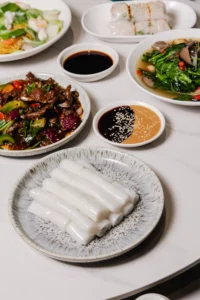
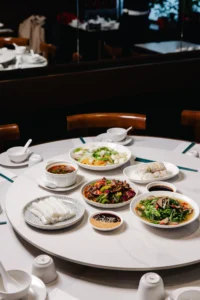
- At Joy King Lau: This tradition comes alive daily. Bamboo steamers arrive bearing translucent Har Gau (shrimp dumplings) and delicate Siu Mai, demanding the same precision and delicate folding techniques mastered by teahouse chefs centuries ago.
2. The Art of Siu Mei (Roasting)
 The sight of lacquered meat hanging in the window is the most iconic visual of London’s Chinatown. The techniques for Cantonese roasting – marinating meats in hoisin, five-spice, and honey, then roasting them in specialised ovens – have been refined over generations.
- At Joy King Lau: The Char Siu (barbecue pork) and crispy-skinned roast duck are testaments to this history, offering the perfect textural contrast between meltingly tender meat and caramelised, crispy exteriors.
3. Mastering Wok Hei (Breath of the Wok)
Cantonese stir-frying requires achieving Wok Hei – the complex, smoky flavour imparted by a searing hot wok over an open flame. It is a fleeting, ephemeral flavour that cannot be replicated in a home kitchen.
- At Joy King Lau: The chefs command the wok with the practised muscle memory of their ancestors. Consequently, they flawlessly stir-fry both simple garlic morning glory and complex ginger crab.
A Timeless Table
In summary, in a city defined by fleeting culinary trends and rapid gentrification, Joy King Lau remains a steadfast anchor. It does not chase Michelin stars with fusion tasting menus or molecular gastronomy. Instead, it offers something much rarer: a direct, unadulterated link to the past.
When you sit down at a round table on Leicester Street, pour a cup of jasmine tea, and lift the lid off a steaming bamboo basket, you are not just having lunch in Soho. You taste the legacy of Silk Road merchants and the resilience of East End sailors. Furthermore, you experience the enduring brilliance of Cantonese culinary history.